MEDIAL DISORDERS VOL II / OPEN CALL PER VOLUME CARTACEO / ITA-ENG
DEADLINE 30 MAGGIO
ENG BELOW
Inactual lancia una nuova open call per selezionare una serie di contributi per il secondo volume della trilogia Medial Disorders (il primo lo trovate qui), un progetto che coinvolge scrittor3, artist3 e accademic3 affermati nel panorama nazionale e internazionale, insieme ad autor3 e artist3 emergenti.
Il primo volume sta girando e continua a girare tra presentazioni, letture performative, seminari universari e screening, attraversando una moltitudine di spazi e ricevendo tanti apprezzamenti di cui non possiamo che essere infinitamente grati.
IL VOLUME:
Come suggerisce il titolo, Medial Disorders. Interpretive and non-statistical compendium of technological disorders si pone innanzitutto come un ribaltamento critico del famoso DSM (Diagnostic and Statistical Manual of mental disorders): il DSM – definito un manuale ateoretico – si basa sulla sintomatologia descrittiva, ignorando una serie di aspetti come la complessità soggettiva, la storia, il contesto socio-economico e tanti altri aspetti. In estrema sintesi, il DSM contribuisce a una logica che sostituisce la cura di una società malata a quella di un adattamento coercitivo e desoggettivante dell’individuo. Questa ideologia opera mediante un’organizzazione dei discorsi che si sviluppa colpevolizzando il soggetto e assolvendo l sistemi di potere che regolano la società in cui è costretto a vivere; inoltre, questa organizzazione dei discorsi si articola, nel caso del DSM, in una struttura manualistica composta da indici, categorie, sottocategorie, neologismi, descrizioni, statistiche basate su sintomi spesso generici: ogni singola parte concorre alla funzione di agevolare e legittimarne il discorso.
Adottando il DSM come emblema dei meccanismi di potere in generale, operanti mediante discorsi e strutture che li sostengono, questo volume intende costruire un détournement ai discorsi (ricerca teorica e artistica) e alle strutture che li sostengono (editoriale) applicandolo però all’ecosistema tecnologico in cui viviamo.
MEDIAL DISORDERS è un volume che intende riflettere sul concetto di disordine mediale, neologismo che si riassume in una visione della tecnologia come organismo neutrale in grado di sviluppare una serie di patologie a causa dell’influenza umana. Non si patologizza dunque la tecnologia in sé, ma il modo in cui viene applicata. Si tratta quindi di un passaggio concettuale che riporta da un lato la responsabilità ultima di ogni utilizzo della tecnologia all’essere umano stesso, a chi la programma, a chi la gestisce, a chi la organizza come forma di potere attraverso discorsi e strutture. Ogni patologia possibile rappresenta dunque un utilizzo distopico, dannoso o negativo per umani, non umani ed ecosistemi. Ognuno di questi utilizzi patologici della tecnologia seguirà dunque una logica inversa rispetto a quella sintomatologica e descrittiva del DSM: (benché si strutturerà mediante categorie, sottocategorie e termini) verranno invece interpretati in maniera critica e in chiave interdisciplinare. Per questa ragione, Medial Disorders non si pone come manuale statistico ma come compendio interpretativo, nella misura in cui si porrà come una guida interpretativa sullo stato dell’arte, di oggi e del futuro, di tutte quelle applicazioni e manifestazioni e utilizzi patologici della tecnologia che costituiscono, regolano e influenzano la vita nel suo complesso.
ESEMPI E GUIDA:
1** Esempi di alcune macro-categorie di medial disorders: Conscious, Unconscious, Psychic & Physiological Medial Disorders; Aesthetics, Visual and Political Medial Disorders; Social Media & Digital Network Disorders; A.I., Data & Algorithmic Medial Disorders; Time, Sound, Space & Urban Medial Disorders.
2** Esempi di medial disorders: Anedonia, Doomscrolling, Urban Gamification, Militarization of AI, NPC stream..
3** L’autor* potrà scegliere un “medial disorder” già esistente, trattato da altri autor* e riassumerlo, oppure potrà indagare qualcosa di specifico e identificare l’analisi con un neologismo.
***La call si rivolge a studios*, ricercator* indipendenti, accademic* e artist*. Non si pone alcun vincolo tematico, se non quello attinente all’intersezione teorica della tecnologia (del medial disorder) con le seguenti macroaree: Visual, Media, Film, Game, Sound Studies / Filosofia / Politica / Antropologia / Sessualità e studi di genere / Ecologia / Arte contemporanea / Sottoculture / Neuroscienze / Psichiatria / Biologia / Sociologia.
COME CANDIDARSI:
Inviare, entro il 30 maggio 2025 una mail a inactual.magazine@gmail.com con oggetto “MEDIAL DISORDER”, allegando 2 PDF separati:
1– titolo (nome del medial disorder) + Nome Cognome autor* + testo definitivo (min 3000 max 4000 battute) + eventuale bibliografia (da citare in nota nel testo).
2 – Breve biografia (max 500 battute) + contatti: sito web / social / altri link
***Il volume verrà pubblicato entro dicembre 2025***
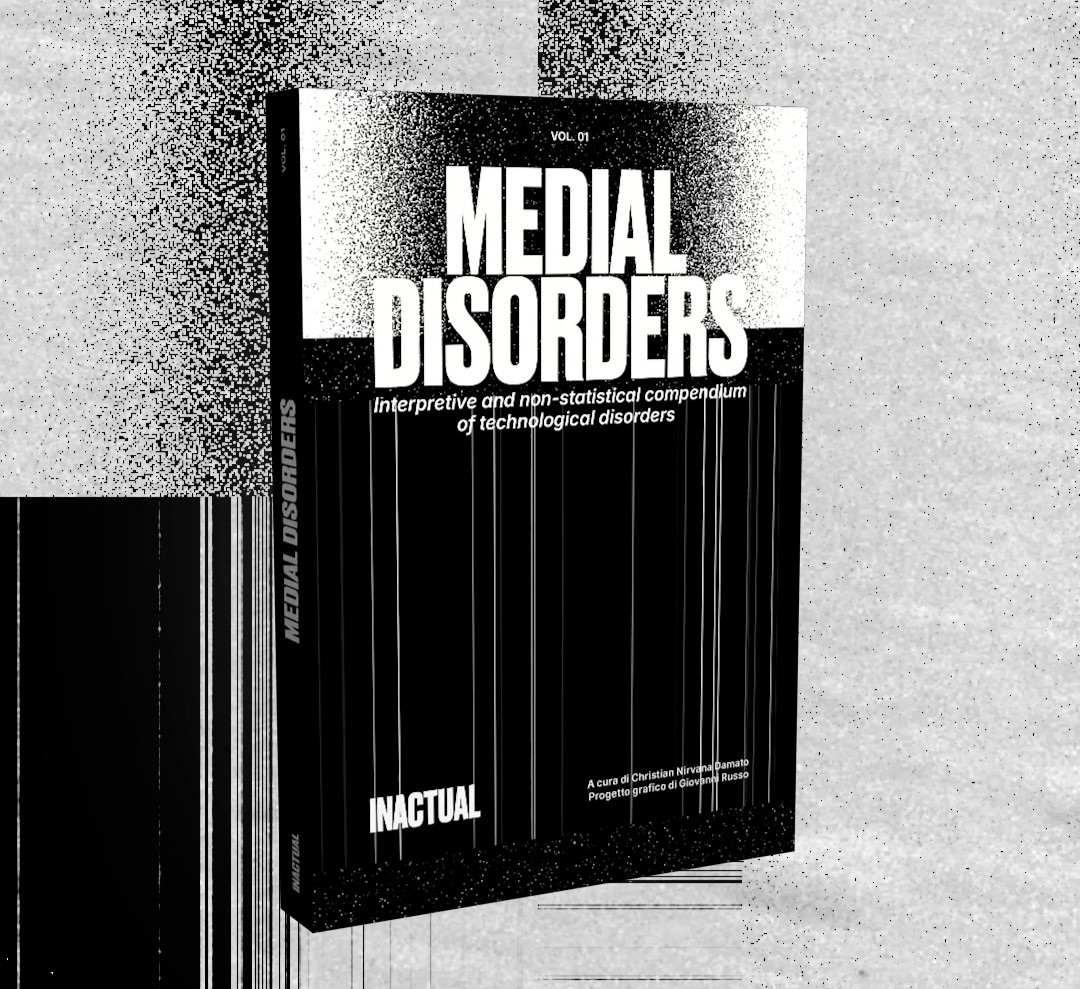
MEDIAL DISORDERS VOL I
Inactual launches a new open call to select a series of contributions for the second volume of the Medial Disorders trilogy (you can find the first one here), a project that involves established writers, artists, and academics from both the national and international scene, alongside emerging authors and artists.
The first volume is circulating and continues to circulate through presentations, performative readings, university seminars, and screenings, crossing a multitude of underground and institutional spaces and receiving much appreciation, for which we can only be infinitely grateful.
THE VOLUME:
As the title suggests, Medial Disorders. Interpretive and Non-Statistical Compendium of Technological Disorders primarily presents itself as a critical reversal of the well-known DSM (Diagnostic and Statistical Manual of Mental Disorders): the DSM—defined as an atheoretical manual—relies on descriptive symptomatology, ignoring a range of aspects such as subjective complexity, history, socio-economic context, and many others. In short, the DSM contributes to a logic that replaces the healing of a sick society with that of a coercive and de-subjectivizing adaptation of the individual. This ideology operates through an organization of discourses that develops by blaming the subject while absolving the power systems that regulate the society in which they are forced to live; moreover, this organization of discourses is structured, in the case of the DSM, into a manual format composed of indexes, categories, subcategories, neologisms, descriptions, and statistics based on often generic symptoms: each individual part contributes to facilitating and legitimizing its discourse.
By adopting the DSM as an emblem of power mechanisms in general, operating through discourses and the structures that support them, this volume aims to construct a détournement of both the discourses (theoretical and artistic research) and the structures that support them (editorial), applying it, however, to the technological ecosystem in which we live.
Medial Disorders is a volume that intends to reflect on the concept of medial disorder, a neologism that encapsulates a vision of technology as a neutral organism capable of developing a series of pathologies due to human influence. Technology itself is therefore not pathologized, but rather the way it is applied. This is thus a conceptual shift that, on the one hand, returns the ultimate responsibility for every use of technology to human beings, to those who program it, manage it, and organize it as a form of power through discourses and structures. Each possible pathology thus represents a dystopian, harmful, or negative use of technology for humans, non-humans, and ecosystems. Each of these pathological uses of technology will therefore follow a logic opposite to the DSM’s symptomatic and descriptive approach: (although it will be structured through categories, subcategories, and terms), they will instead be interpreted critically and in an interdisciplinary key. For this reason, Medial Disorders does not present itself as a statistical manual but as an interpretive compendium, insofar as it will serve as an interpretive guide to the state of the art—of today and the future—of all those applications, manifestations, and pathological uses of technology that shape, regulate, and influence life as a whole.
EXAMPLES AND GUIDELINES:
1 Examples of some macro-categories of medial disorders: Conscious, Unconscious, Psychic & Physiological Medial Disorders; Aesthetics, Visual and Political Medial Disorders; Social Media & Digital Network Disorders; A.I., Data & Algorithmic Medial Disorders; Time, Sound, Space & Urban Medial Disorders.
2 Examples of medial disorders: Anhedonia, Doomscrolling, Urban Gamification, Militarization of AI, NPC Streaming.
3 The author may choose an already existing “medial disorder” previously addressed by other authors and summarize it, or may investigate something specific and identify the analysis with a new term (neologism).
The call is addressed to scholars, independent researchers, academics, and artists. There are no thematic constraints, except for the requirement that the contribution relates to the theoretical intersection of technology (of the medial disorder) with the following macro-areas: Visual, Media, Film, Game, Sound Studies / Philosophy / Politics / Anthropology / Sexuality and Gender Studies / Ecology / Contemporary Art / Subcultures / Neuroscience / Psychiatry / Biology / Sociology.
HOW TO APPLY:
Send an email to inactual.magazine@gmail.com by May 30, 2025, with the subject “MEDIAL DISORDER”, attaching two separate PDFs:
1– Title (name of the medial disorder) + Full Name of the Author + Final Text (min 3,000 max 4,000 characters) + Any Bibliography (to be cited in footnotes within the text).
2– Short biography (max 500 characters) + Contacts: Website / Social Media / Other Links.
The volume will be published by December 2025
© INACTUAL